
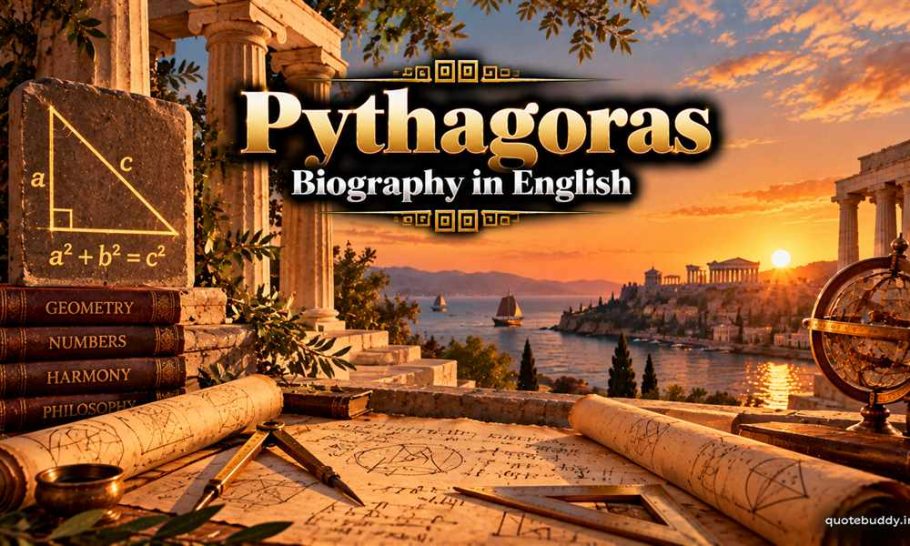
Pythagoras was an ancient Greek mathematician and philosopher best known for the Pythagorean theorem, one of the most fundamental rules in geometry. Beyond mathematics, he founded a school in Croton that combined the study of numbers, music and philosophy with spiritual discipline. This biography looks at his early life, travels, the Pythagorean school, his mathematical contributions, philosophy and lasting legacy.
Early Life
Pythagoras was an ancient Greek mathematician and philosopher who is remembered for his contributions to mathematics, music and philosophy. He was born around 570 BCE on the Greek island of Samos. Very little is known about his early life because most accounts were written long after his death. His father is traditionally identified as Mnesarchus, a merchant. As a young man, Pythagoras is believed to have developed an interest in numbers, patterns and the natural world. These interests later became central to his teachings and the school he established.
During Pythagoras’s lifetime, Greek thinkers were exploring questions about nature, the universe and human knowledge. He became interested in understanding how the world worked through reason and observation. Unlike many modern mathematicians, he was also deeply concerned with spiritual questions and the way people should live. His ideas combined mathematics with religious beliefs and moral discipline. Since reliable records from his time are limited, some stories about his childhood and achievements may be legendary. Nevertheless, Pythagoras became one of the most influential figures in ancient Greek intellectual history.
Travels and Education
Ancient accounts suggest that Pythagoras travelled to different regions to learn from religious teachers, scholars and philosophers. Some stories describe journeys to Egypt and Babylon, where he may have encountered mathematical knowledge, astronomy and religious traditions. However, historians cannot confirm every detail of these journeys. Trade and cultural contact connected the ancient Greek world with other civilisations, making the exchange of ideas possible. These possible influences may have helped shape Pythagoras’s interest in numbers, geometry and the relationship between mathematics and the natural world.
Pythagoras eventually left Samos and settled in Croton, a Greek city in southern Italy, around the sixth century BCE. There, he attracted followers who were interested in his teachings about mathematics, ethics and spiritual life. His approach was different from simply teaching facts or calculations. He encouraged his followers to study carefully, follow discipline and search for deeper principles behind everyday experiences. His reputation grew, and his ideas influenced the intellectual and religious life of the community. Croton became the main centre of his teaching and the starting point for the Pythagorean tradition.
The Pythagorean School
Pythagoras established a community of followers in Croton that became known as the Pythagorean school. It was not simply a modern school where students attended classes. It combined learning, shared living, religious practices and strict rules about personal behaviour. Members studied mathematics, music, philosophy and the natural world. They were expected to live disciplined lives and respect the group’s traditions. Some accounts suggest that women were also members of the community, which was unusual in many ancient Greek settings. The school helped spread Pythagorean ideas beyond its original location.
The Pythagorean community believed that numbers and mathematical relationships could explain important features of the universe. Members studied patterns in geometry, music and astronomy, looking for order in the world around them. They also followed rules related to food, behaviour and spiritual purity. Because many teachings were shared within the group, it is difficult to identify which discoveries came directly from Pythagoras and which were made by his followers. For this reason, historians often use the term “Pythagorean” when discussing ideas connected with the school. Its influence continued long after Pythagoras’s lifetime.
Mathematical Contributions
Pythagoras is most famously associated with the Pythagorean theorem, a fundamental rule in geometry. It states that in a right-angled triangle, the square of the longest side equals the sum of the squares of the other two sides. This relationship is written as a²+b²=c². The theorem is widely used in mathematics, architecture, engineering and construction. However, evidence shows that similar relationships were known in earlier civilisations, including Babylon. It is therefore uncertain whether Pythagoras discovered the theorem himself, proved it, or helped develop its place in Greek mathematics.
The Pythagorean school also explored the relationship between numbers and musical harmony. Its members observed that pleasing musical sounds could be produced by strings whose lengths followed simple numerical ratios. This helped strengthen their belief that mathematics could explain patterns in nature. They studied even and odd numbers, geometric shapes and numerical relationships. Their work contributed to the development of mathematical thinking in ancient Greece. Although many discoveries are difficult to attribute to Pythagoras personally, the tradition associated with his name helped establish mathematics as a way to understand not only quantities but also the structure and order of the world.
Philosophy and Beliefs
Pythagoras believed that numbers were deeply connected with the nature of reality. For him and his followers, mathematical relationships revealed an underlying order in the universe. This idea influenced later philosophers and thinkers who tried to explain nature through patterns and logical principles. Pythagoras’s philosophy also included spiritual beliefs, especially the idea that the soul continued to exist after death and could be reborn in another body. This belief is known as the transmigration of souls. It encouraged followers to live carefully and think about the moral consequences of their actions.
Pythagorean teachings emphasised self-discipline, friendship, learning and respect for a balanced life. Music and mathematics were considered important because they could help people understand harmony and order. Members of the school followed various rules intended to support spiritual purity and control over personal desires. Some traditions also connect them with vegetarian practices, although the exact rules followed by Pythagoras and his followers remain uncertain. His philosophy brought together intellectual study and personal conduct. Rather than treating knowledge as separate from everyday life, the Pythagorean tradition encouraged people to use learning to improve themselves.
Legacy
Pythagoras remains one of the most famous names in the history of mathematics and philosophy. The theorem associated with him is taught in schools across the world and continues to be useful in practical and scientific work. His name is also linked with early efforts to understand the relationship between numbers, music and nature. Although historians cannot confirm that he personally made every discovery attributed to him, the Pythagorean school played an important role in the development of Greek mathematical thought. Its approach helped influence later scholars who explored geometry, astronomy and philosophical questions.
Pythagoras’s influence extended beyond mathematics into philosophy, music and ideas about the soul. His followers encouraged the belief that careful study could reveal order in the universe, while their emphasis on discipline connected learning with moral development. Later Greek thinkers, including Plato, were influenced by ideas associated with the Pythagorean tradition. Today, Pythagoras is remembered as a symbol of curiosity, logical thinking and the search for knowledge. His life also reminds us that historical discoveries often develop through the work of many people over time. His name continues to inspire students learning mathematics and exploring the wonders of the natural world.
Quick Facts
- Full Name: Pythagoras of Samos
- Born: c. 570 BCE, Samos, Greece
- Died: c. 495 BCE, likely in southern Italy
- Profession: Mathematician, Philosopher
- Known For: Pythagorean theorem, the Pythagorean school, number-music-nature philosophy
Timeline
- c. 570 BCE: Born on the island of Samos, Greece
- Youth: Possible travels to Egypt and Babylon for learning
- 6th century BCE: Settled in Croton, southern Italy
- Croton years: Founded the Pythagorean school
- c. 495 BCE: Died, likely in southern Italy
Why It Matters
Pythagoras’s ideas shaped how mathematics, music and philosophy came to be understood as interconnected fields revealing order in nature. The Pythagorean theorem remains foundational to geometry, architecture and engineering, making his legacy relevant to students and professionals worldwide even today.
Recommended Book
For readers interested in learning more about Pythagoras and ancient Greek mathematics, several accessible books are available. Search for Pythagoras biography books on Amazon.in.
Frequently Asked Questions
Q1. What is Pythagoras most famous for?
He is most famous for the Pythagorean theorem, which relates the sides of a right-angled triangle.
Q2. Did Pythagoras discover the Pythagorean theorem?
Historians are uncertain; similar mathematical relationships were known in earlier civilisations such as Babylon, so his exact contribution remains debated.
Q3. What was the Pythagorean school?
It was a community Pythagoras founded in Croton, Italy, combining study of mathematics, music and philosophy with disciplined communal living.
Q4. What did Pythagoras believe about the soul?
He believed in the transmigration of souls, the idea that the soul continues after death and can be reborn in another body.
Also read: Leonardo da Vinci Biography in English
