
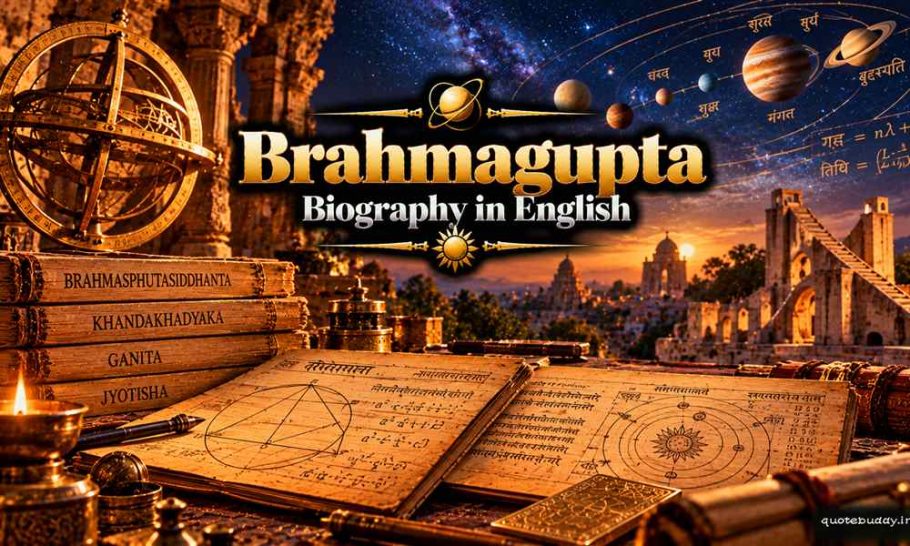
Brahmagupta was a famous ancient Indian mathematician and astronomer who made important contributions to mathematics and the study of the universe. He was born around 598 CE in the region of northwestern India, traditionally associated with Bhinmal in present-day Rajasthan. He lived during a period when Indian scholars were making significant advances in science, mathematics, and astronomy. Although details about his childhood are limited, his surviving works show that he developed a deep understanding of numbers, calculations, and celestial movements. His discoveries later influenced scholars in India and other parts of the world.
Early Life
Brahmagupta lived during the rule of the early medieval Indian kingdoms, when astronomy was important for calendars, religious festivals, and understanding the movements of planets. He studied earlier scientific ideas and developed new methods to solve mathematical problems. His work combined careful calculations with practical knowledge of astronomy. Unlike many historical figures whose lives are well documented, little is known about his family or personal experiences. Most information about him comes from his own writings. These works have helped historians understand his achievements and his important place in the history of Indian science.
Education
There are limited historical records about Brahmagupta’s formal education, teachers, or childhood learning. However, his writings demonstrate that he received advanced training in mathematics and astronomy. During his time, Indian scholars learned through established schools of knowledge, studying earlier texts, mathematical rules, astronomical observations, and methods of calculation. Brahmagupta was familiar with the scientific traditions that developed before him. He carefully examined earlier ideas and sometimes corrected or improved them. His ability to explain difficult mathematical concepts through clear rules suggests that he had extensive knowledge of the scholarly methods of his period.
Brahmagupta’s education also included the practical study of astronomy, which required mathematical skills to calculate planetary positions, eclipses, and calendar dates. He worked with numerical systems and developed methods for handling positive and negative quantities. His writings show that he understood arithmetic, algebra, geometry, and astronomical calculations. Rather than simply repeating earlier teachings, he evaluated existing methods and introduced new solutions. His learning allowed him to connect mathematical reasoning with real astronomical questions. These skills helped him become one of the leading scholars of his time and a major figure in the development of Indian mathematics.
Career and Works
Brahmagupta became a respected scholar of mathematics and astronomy. He is associated with Ujjain, an important centre of astronomical learning in ancient India. Around 628 CE, when he was approximately thirty years old, he wrote his famous book Brahmasphutasiddhanta. The title is often translated as “The Correctly Established Doctrine of Brahma.” This work discussed mathematical rules, planetary movements, eclipses, and other astronomical subjects. It also included important ideas about zero and negative numbers. The book became influential among later Indian scholars and helped preserve mathematical knowledge for future generations.
In 665 CE, Brahmagupta wrote another important work called Khandakhadyaka, which focused mainly on practical astronomy and calculations. It provided methods for determining planetary positions and preparing astronomical tables. Brahmagupta wrote in Sanskrit verse, following the scholarly traditions of his time. His books combined theoretical explanations with procedures that other scholars could use. Some of his ideas disagreed with those of earlier astronomers, showing that he was willing to question established opinions. Through these works, Brahmagupta helped strengthen India’s reputation as an important centre of mathematical and astronomical learning.
Major Contributions to Mathematics
Brahmagupta made important advances in arithmetic, algebra, and the mathematical treatment of zero. In his Brahmasphutasiddhanta, he described rules for calculations involving zero, positive numbers, and negative numbers. He understood positive quantities as fortunes and negative quantities as debts, using these familiar ideas to explain mathematical operations. His work helped establish a systematic way to calculate with different types of numbers. Some of his rules involving division by zero were incomplete or incorrect by modern standards, but his efforts were an important step in the development of arithmetic.
Brahmagupta also contributed to algebra and geometry. He gave methods for solving certain quadratic equations and worked with equations involving unknown quantities. In geometry, he described a famous formula for finding the area of a cyclic quadrilateral, a four-sided shape whose corners lie on a circle. The formula uses the lengths of all four sides and is known today as Brahmagupta’s formula. His mathematical rules were written in a form that scholars could remember and apply. These contributions helped influence later mathematical work in India and beyond.
Contributions to Astronomy
Brahmagupta made major contributions to astronomy by developing methods to calculate the positions and movements of celestial bodies. His writings discussed the Sun, Moon, planets, and stars, as well as the calculation of solar and lunar eclipses. Astronomy was important in his society because it helped people prepare calendars and determine dates for religious and cultural events. Brahmagupta used mathematical techniques to improve astronomical calculations and explain how celestial movements could be predicted. His work built on earlier Indian astronomical traditions while also introducing his own interpretations and corrections.
Brahmagupta also studied the apparent movement of planets and the changing positions of the Moon and Sun. His book Khandakhadyaka provided practical procedures for astronomical calculations and became useful to later scholars. Some of his explanations reflected the scientific understanding of his era and differ from modern astronomy. Nevertheless, his ability to apply mathematics to observations of the sky was significant. His works were later studied and transmitted beyond India, including through translations into Arabic. This helped Indian mathematical and astronomical ideas reach scholars in other regions and contributed to the wider history of science.
Later Years and Legacy
Very little is known about Brahmagupta’s final years or the exact date of his death. Historical evidence mainly survives through his mathematical and astronomical writings, rather than detailed records of his personal life. His books continued to be studied after his lifetime, and later scholars examined, adapted, and sometimes challenged his ideas. His association with Ujjain reflects the importance of Indian centres of learning during this period. Although he lived more than a thousand years ago, his work remains an important source for understanding how mathematics and astronomy developed in early medieval India.
Brahmagupta is remembered today as one of the great scholars in the history of mathematics. His work on zero, negative numbers, algebra, and geometry helped shape later mathematical traditions, while his astronomical writings supported the study of celestial movements. His ideas travelled beyond India through scholarly exchanges and translations, influencing the wider development of science. Modern mathematics has advanced far beyond the methods of his time, but his achievements remain historically important. Brahmagupta’s legacy demonstrates how careful reasoning, observation, and the sharing of knowledge can contribute to discoveries that continue to interest people across generations.
Quick Facts
- Full Name: Brahmagupta
- Born: c. 598 CE, Bhinmal, present-day Rajasthan, India
- Known For: Rules for zero and negative numbers, Brahmagupta’s formula, algebra
- Profession: Mathematician, Astronomer
- Associated With: Ujjain, ancient centre of astronomical learning
- Major Works: Brahmasphutasiddhanta (628 CE), Khandakhadyaka (665 CE)
Timeline
- c. 598 CE: Born in Bhinmal, present-day Rajasthan
- 628 CE: Wrote Brahmasphutasiddhanta, introducing rules for zero and negative numbers
- 665 CE: Wrote Khandakhadyaka, focused on practical astronomy
- Later centuries: His works translated into Arabic, influencing scholars beyond India
Why It Matters
Brahmagupta’s rules for zero and negative numbers laid essential groundwork for modern arithmetic and algebra, while his astronomical calculations advanced the understanding of celestial movements. His ideas travelled across cultures through translation, linking ancient Indian scholarship to the wider history of world mathematics.
Recommended Book
To learn more about Brahmagupta’s life and contributions, readers may enjoy exploring books on the history of Indian mathematics and astronomy. Search for Brahmagupta books on Amazon.in
Frequently Asked Questions
Q: What is Brahmagupta famous for?
A: Brahmagupta is famous for his rules governing zero and negative numbers, his formula for the area of a cyclic quadrilateral, and his contributions to astronomy.
Q: What is Brahmagupta’s most important book?
A: His most important book is the Brahmasphutasiddhanta, written in 628 CE, which covers mathematics and astronomy, including ideas about zero and negative numbers.
Q: Where did Brahmagupta work?
A: Brahmagupta is associated with Ujjain, an important centre of astronomical learning in ancient India.
Q: How did Brahmagupta’s work spread beyond India?
A: His works were later translated into Arabic, helping Indian mathematical and astronomical ideas reach scholars in other regions.
Also read: Biography of Aryabhatta in English: Life, Astronomy & Books 2026
