
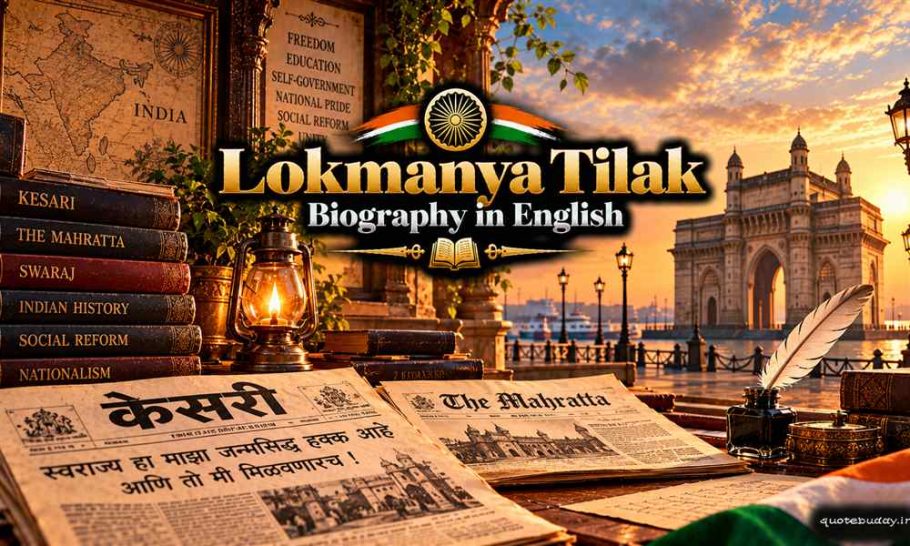
Lokmanya Bal Gangadhar Tilak was a famous Indian freedom fighter, teacher, journalist, and social reformer who played an important role in India’s struggle for independence. He was born on July 23, 1856, in Ratnagiri, Maharashtra, India. His father, Gangadhar Ramachandra Tilak, was a respected teacher and Sanskrit scholar, while his mother was Parvatibai. Tilak grew up in a family that valued education, discipline, and Indian traditions. From an early age, he showed intelligence, courage, and a strong sense of justice, qualities that later shaped his political activities.
Early Life
During his childhood, Tilak developed a deep interest in Indian culture, history, and education. He was known for his sharp mind and independent thinking. He believed that people should understand their rights and work together to improve society. As he grew older, he became concerned about British rule in India and its effects on Indian people. These concerns gradually inspired him to dedicate his life to public service and national freedom. His determination and strong beliefs eventually made him one of the most influential leaders of India’s independence movement.
Education
Bal Gangadhar Tilak received his early education in Maharashtra, where his father worked as a teacher. He was a bright student who performed well in his studies and showed a particular interest in mathematics and Sanskrit. His education helped him develop logical thinking, discipline, and a strong understanding of Indian traditions. He believed that education was essential for building a confident and independent society. During his student years, he also began questioning unfair practices and the restrictions imposed by British rule, which influenced his later interest in politics and social reform.
Tilak studied at Deccan College in Pune, where he earned a Bachelor of Arts degree in mathematics in 1877. He later completed a Bachelor of Laws degree in 1879. Although he qualified in law, he decided to focus on education and public service rather than becoming a full-time lawyer. He believed that Indians needed access to education that developed their confidence and national awareness. His academic background gave him the skills to analyse political issues and explain his ideas clearly. These abilities later helped him become a respected teacher, journalist, and nationalist leader.
Career Beginnings
After completing his education, Bal Gangadhar Tilak decided to work in the field of education. In 1880, he helped establish the New English School in Pune with like-minded colleagues, including Gopal Ganesh Agarkar and Vishnushastri Chiplunkar. Their aim was to provide quality education while encouraging students to think independently and understand Indian society. Tilak believed that education should prepare young people to serve their country. His work as a teacher allowed him to influence students and spread his ideas about national pride, discipline, and the importance of developing an educated Indian population.
In 1884, Tilak and his associates helped establish the Deccan Education Society, which aimed to expand educational opportunities. Fergusson College was founded in Pune in 1885 under the society’s educational efforts. Tilak also entered journalism to reach a wider audience. In 1881, he helped launch the Marathi newspaper Kesari and the English newspaper The Mahratta. Through these publications, he discussed political issues, criticised British policies, and encouraged Indians to become more active in public life. His educational and journalistic work became the foundation of his growing role in India’s freedom movement.
Freedom Struggle and Political Career
Bal Gangadhar Tilak became one of the strongest voices against British rule in India. He believed that Indians should demand self-government rather than wait for the British authorities to introduce reforms. His famous slogan, “Swaraj is my birthright and I shall have it,” became closely associated with India’s independence movement. Tilak encouraged people to participate in political activities and challenge unjust policies. His direct approach made him popular among many Indians, although it also brought him into conflict with British officials, who viewed his writings and speeches as a threat to colonial authority.
Tilak played an important role in the Indian National Congress and became associated with its more assertive nationalist group. In 1908, British authorities arrested him and sentenced him to six years of imprisonment in Mandalay, Burma, now Myanmar. During this period, he wrote The Arctic Home in the Vedas, exploring his ideas about ancient Indian history. After his release in 1914, he returned to political activity and helped establish the All India Home Rule League in 1916. He worked to build support for self-government and encouraged cooperation among Indians seeking greater political freedom.
Writings and Social Reform
Bal Gangadhar Tilak used newspapers, books, and public speeches to spread his political and social ideas. Through Kesari and The Mahratta, he criticised British rule and encouraged Indians to become aware of their rights. He also wrote important works such as The Arctic Home in the Vedas and Shrimad Bhagavad Gita Rahasya. In the latter, he explained his interpretation of the Bhagavad Gita, emphasising action and duty. His writing connected Indian philosophical traditions with his belief that people should actively work for society and the nation.
Tilak also used public celebrations to strengthen unity and national awareness. In Maharashtra, he helped popularise the public celebration of Ganesh Chaturthi and promoted Shivaji festivals as ways to bring people together. These gatherings created opportunities for public discussion and helped spread nationalist ideas beyond educated groups. However, Tilak’s views on certain social reforms, including the pace and method of changing traditional customs, differed from those of some reformers. His legacy in social reform is therefore complex. He is especially remembered for using education, journalism, cultural events, and public organisation to encourage political awareness.
Later Years and Legacy
In his later years, Bal Gangadhar Tilak continued working for India’s self-government despite facing imprisonment and health challenges. After returning from Mandalay in 1914, he renewed his political activities and sought to unite different groups within the nationalist movement. In 1916, he helped launch the Home Rule movement in India, demanding greater control over the country’s affairs. He also supported efforts to bring political groups closer together, including the agreement reached between the Indian National Congress and the Muslim League at Lucknow in 1916. His efforts helped strengthen the demand for Indian self-rule.
Bal Gangadhar Tilak died on August 1, 1920, in Bombay, now Mumbai, at the age of sixty-four. His death led to widespread mourning, and he was remembered as one of the leading figures of India’s freedom struggle. The title “Lokmanya,” meaning “accepted by the people,” reflected the respect he earned among many Indians. His courage, journalism, educational work, and demand for Swaraj influenced later national leaders, including Mahatma Gandhi. Tilak’s legacy remains an important part of Indian history, representing determination, national pride, and the belief that Indians should have the right to govern their own country.
Quick Facts
- Full Name: Bal Gangadhar Tilak
- Born: 23 July 1856, Ratnagiri, Maharashtra, India
- Died: 1 August 1920, Bombay (Mumbai), India (aged 64)
- Profession: Freedom Fighter, Teacher, Journalist, Social Reformer
- Known For: “Swaraj is my birthright” slogan, founding Kesari newspaper, Home Rule League
- Title: “Lokmanya” (accepted by the people)
Timeline
- 1856: Born in Ratnagiri, Maharashtra
- 1880: Co-founded the New English School in Pune
- 1881: Launched the newspapers Kesari and The Mahratta
- 1885: Fergusson College founded under the Deccan Education Society
- 1908: Arrested and imprisoned in Mandalay, Burma
- 1916: Founded the All India Home Rule League
- 1920: Died in Bombay
Why It Matters
Lokmanya Tilak’s demand for self-government and his slogan “Swaraj is my birthright” helped transform India’s independence movement from a request for reforms into an assertive demand for self-rule, directly influencing leaders like Mahatma Gandhi who followed him.
Recommended Book
To learn more about Lokmanya Tilak’s life and contributions to India’s freedom struggle, readers may enjoy exploring biographies about his work. Search for Lokmanya Tilak books on Amazon.in
Frequently Asked Questions
Q: What is Lokmanya Tilak famous for?
A: Tilak is famous for his slogan “Swaraj is my birthright and I shall have it,” and for his leadership in India’s independence movement through journalism, education, and political activism.
Q: What newspapers did Tilak start?
A: He founded the Marathi newspaper Kesari and the English newspaper The Mahratta in 1881 to spread his political ideas.
Q: Why was Tilak imprisoned?
A: British authorities arrested him in 1908 and sentenced him to six years in Mandalay, Burma, for his writings against colonial rule.
Q: What does “Lokmanya” mean?
A: “Lokmanya” means “accepted by the people,” a title reflecting the widespread respect he earned among Indians.
Also read: Biography of Bhagat Singh in English: Life, Achievements & Books 2026
