
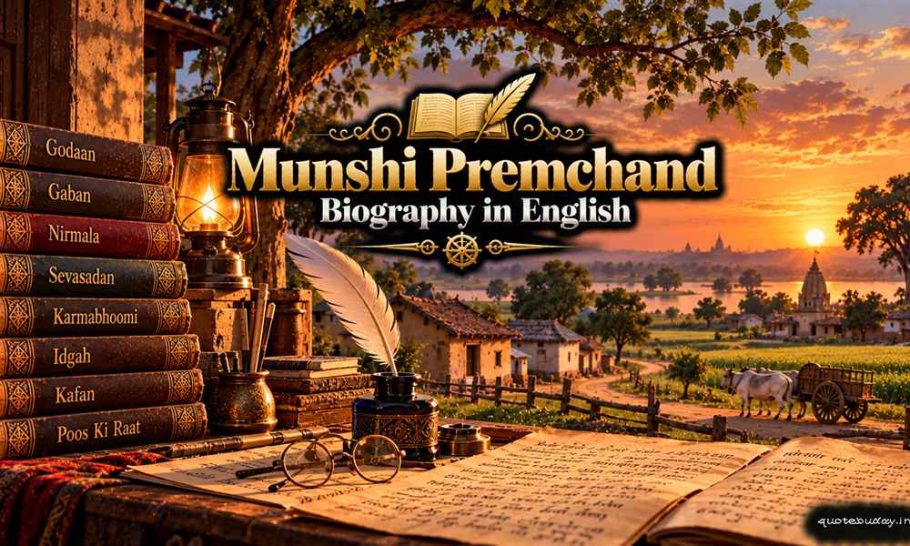
Munshi Premchand was one of India’s most respected writers, known for his realistic stories about ordinary people and social problems. His real name was Dhanpat Rai Srivastava. He was born on 31 July 1880 in Lamhi, a village near Varanasi in present-day Uttar Pradesh, India. His father, Ajaib Lal, worked as a postal clerk, and his mother was Anand Devi. Premchand grew up in a modest family and experienced difficulties from an early age. These experiences later helped him understand the struggles of poor families and rural communities.
Early Life
Premchand’s childhood was marked by personal loss and financial challenges. His mother died when he was young, and his father later remarried. He developed an interest in reading and storytelling despite having limited resources. He enjoyed books and gradually became familiar with different literary traditions. His early experiences exposed him to the realities of poverty, inequality, and family responsibilities. These subjects later became central to his writing. Rather than focusing only on kings, heroes, or imaginary worlds, Premchand chose to describe ordinary people and the problems they faced in everyday life.
Education
Munshi Premchand received his early education in local schools near his village. He studied Urdu and Persian, which introduced him to important literary traditions and influenced his later writing. He also developed an interest in reading novels and other literary works. His family had limited financial resources, so he had to manage his studies alongside personal responsibilities. Despite these challenges, Premchand continued learning and gradually developed strong language skills. His early education helped him become comfortable with both Urdu and Hindi, allowing him to reach readers from different linguistic backgrounds.
After completing his early studies, Premchand continued his education while beginning to support himself through work. He eventually passed his matriculation examination and pursued further learning alongside his teaching responsibilities. His academic journey was not easy because financial pressure and family duties often interrupted his studies. However, he remained committed to education and self-improvement. His knowledge of languages, literature, and society became valuable in his writing career. Through his stories and novels, he later showed that education could help people understand social problems and develop a more thoughtful view of the world around them.
Career Beginnings
Munshi Premchand began his professional life as a teacher in the late nineteenth century. While working, he continued reading and writing stories in his spare time. Initially, he wrote under the pen name Nawab Rai. His early literary work was influenced by the society around him and the difficulties experienced by ordinary people. In 1907, he published Soz-e-Watan, a collection of patriotic stories written in Urdu. The British colonial authorities considered the collection politically sensitive, and copies were reportedly confiscated. This experience marked an important stage in his development as a writer.
Premchand later adopted the name Munshi Premchand, under which he became widely known. He continued writing in Urdu and Hindi, gradually establishing himself as an important literary voice. His stories explored family relationships, poverty, social injustice, and the effects of traditional customs. Unlike many writers of his time, he often used realistic characters and everyday situations instead of idealised heroes. His simple language made his work accessible to a wide audience. As his reputation grew, Premchand became known for writing literature that entertained readers while also encouraging them to think about the problems affecting Indian society.
Famous Works and Writing Style
Munshi Premchand wrote many influential stories and novels that remain important in Hindi and Urdu literature. Some of his best-known works include Godaan, Gaban, Nirmala, Sevasadan, and Karmabhoomi. His short stories, such as “Idgah,” “Kafan,” and “Poos Ki Raat,” are widely read for their emotional depth and realistic descriptions of everyday life. In Godaan, published in 1936, he portrayed the struggles of a poor farmer named Hori. The novel is especially remembered for its treatment of rural poverty, debt, and social inequality.
Premchand’s writing style was direct, realistic, and closely connected to Indian life. He wrote about farmers, workers, women, children, and families facing difficult choices. His characters often struggled against poverty, unfair social customs, and powerful people who controlled their lives. He used familiar language and believable situations to make his stories meaningful to ordinary readers. Rather than presenting society as perfect, he showed its weaknesses and contradictions. This realistic approach helped establish him as a major figure in modern Indian literature and influenced many writers who followed him.
Social Themes and Influence
Munshi Premchand used literature to examine serious social issues, including poverty, caste discrimination, gender inequality, exploitation, and the difficulties faced by rural communities. He believed that writing should reflect real life and encourage people to think about injustice. His stories often showed how social customs and economic pressures could harm individuals and families. He also wrote about the dignity of labour and the importance of compassion. By giving ordinary people a central place in literature, Premchand helped readers understand experiences that were often overlooked in more traditional forms of storytelling.
Premchand’s work also reflected the political and social changes taking place in India during British rule. He supported the idea that writers should engage with the problems of their time. In 1936, he presided over the first conference of the Progressive Writers’ Association in Lucknow, an important event in the development of socially conscious Indian literature. His writing encouraged later authors to explore inequality, working-class life, and human dignity. Although his stories were rooted in the society of his own time, many of their themes remain relevant because poverty, discrimination, and the struggle for fairness continue to affect communities today.
Later Years and Legacy
During his later years, Munshi Premchand continued writing stories, novels, essays, and plays while also working in journalism and film. In 1934, he briefly worked in the Bombay film industry as a screenwriter. However, he did not remain there for long and returned to his literary work. Despite health problems and financial difficulties, he continued producing important writing. His final major novel, Godaan, was published in 1936, the year of his death. The book brought together many of the themes that had shaped his career, especially the struggles of farmers and the effects of social inequality.
Munshi Premchand died on 8 October 1936 in Varanasi, India, at the age of 56. He is remembered as one of the greatest writers in modern Hindi and Urdu literature. His stories and novels continue to be read in schools, colleges, and homes across India. His ability to describe ordinary people with honesty and compassion gave his work lasting value. Premchand helped make literature a powerful way to discuss social problems and human dignity. His legacy continues to inspire writers and readers who believe that stories can deepen understanding and encourage positive change.
Quick Facts
- Full Name: Dhanpat Rai Srivastava (pen name Munshi Premchand)
- Born: 31 July 1880, Lamhi, near Varanasi, Uttar Pradesh, India
- Died: 8 October 1936, Varanasi, India (aged 56)
- Profession: Writer, Novelist, Teacher
- Known For: Godaan, Gaban, Nirmala, “Idgah,” “Kafan”
- Languages: Wrote in Hindi and Urdu
Timeline
- 1880: Born in Lamhi, near Varanasi
- 1907: Published Soz-e-Watan under the pen name Nawab Rai
- 1930s: Established as Munshi Premchand, a major literary voice
- 1934: Briefly worked as a screenwriter in Bombay
- 1936: Presided over the Progressive Writers’ Association conference; published Godaan
- 1936: Died in Varanasi
Why It Matters
Munshi Premchand’s realistic portrayal of poverty, caste discrimination, and rural struggle transformed Hindi and Urdu literature from idealised storytelling into a powerful tool for social reflection. His influence on the Progressive Writers’ Association helped shape generations of socially conscious Indian authors who followed his example.
Recommended Book
To learn more about Munshi Premchand’s life and literary works, readers may enjoy exploring Godaan and his collected short stories. Search for Munshi Premchand books on Amazon.in
Frequently Asked Questions
Q: What is Munshi Premchand famous for?
A: He is famous for realistic novels and short stories like Godaan, Gaban, Nirmala, and “Kafan,” which explored poverty, caste, and social injustice in Indian society.
Q: What was Munshi Premchand’s real name?
A: His real name was Dhanpat Rai Srivastava; he first wrote under the pen name Nawab Rai before adopting Munshi Premchand.
Q: What is Premchand’s most famous novel?
A: Godaan, published in 1936, is considered his masterpiece, portraying the struggles of a poor farmer named Hori.
Q: How did Munshi Premchand die?
A: He died on 8 October 1936 in Varanasi, India, at the age of 56, the same year his novel Godaan was published.
Also read: Goswami Tulsidas Biography in English
