
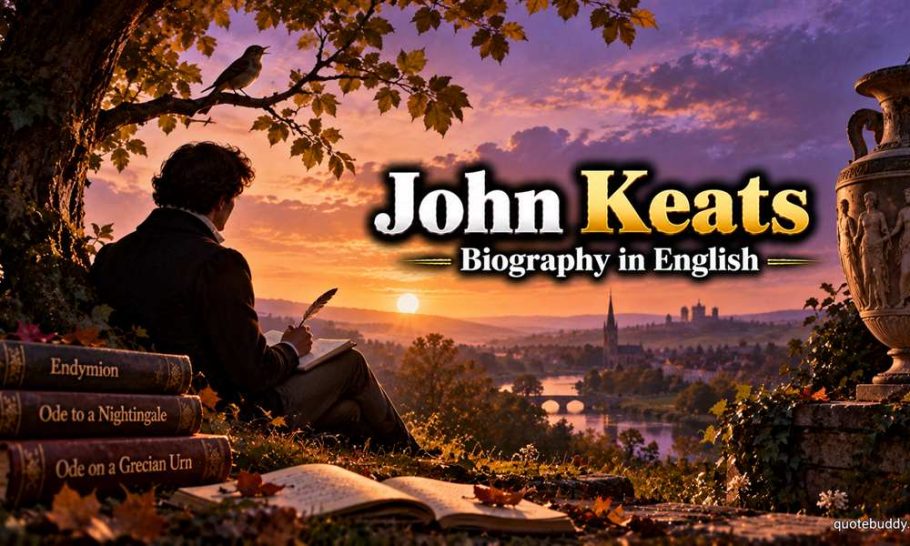
Biography of John Keats — John Keats was an English Romantic poet known for his vivid imagery and his odes on beauty, mortality and nature. He died young but became one of the most celebrated poets in English literature.
Early Life
John Keats was born on 31 October 1795 in London, England. His childhood was marked by the loss of his father, who died when Keats was young. Later, his mother also died of tuberculosis. These losses became important parts of his early life and shaped the difficult circumstances he experienced before becoming a poet. Despite these challenges, Keats developed into an important figure in English Romantic poetry. His life was short, but his literary work eventually brought him wide recognition after his death.
The early loss of both parents meant that Keats experienced personal hardship at a young age. His mother’s death from tuberculosis was especially significant because Keats would later suffer from the same illness. Before his literary career fully developed, he followed a different professional path and trained as a surgeon-apothecary. His early experiences, however, were followed by a growing commitment to poetry. He later became part of the English Romantic poetry movement alongside poets such as Shelley and Byron.
Medical Training and Turn to Poetry
Keats trained as a surgeon-apothecary before choosing poetry as his main path. His medical training gave him a professional direction in his younger years, but he eventually decided to devote himself to writing. This change marked an important turning point in his life. Instead of continuing with medicine, he pursued poetry and became part of the English Romantic movement, where his work developed a distinctive focus on beauty, mortality, and nature.
His decision to choose poetry led him toward a literary career that would become increasingly important. Keats published poetry collections including Endymion, establishing himself as a young poet during the Romantic period. His writing became known for vivid imagery and for exploring ideas connected with beauty, mortality, and the natural world. Although his life was brief, his decision to leave medical training for poetry produced a body of work that later gained lasting recognition.
Friendship with Fellow Romantic Poets
John Keats was part of the English Romantic poetry movement alongside Percy Bysshe Shelley and Lord Byron. These poets became important figures in the Romantic period, a literary movement associated with strong attention to imagination, emotion, nature, and individual experience. Keats developed his own poetic identity within this movement, becoming known for vivid imagery and themes involving beauty, mortality, and nature.
Keats’s place among the Romantic poets became an important part of his literary story. His work existed alongside the poetry of Shelley and Byron during a significant period of English literature. His own poems focused strongly on beauty and the natural world while also considering mortality. Although his career was short, his connection with the Romantic movement helped establish him as one of the poets whose work became widely celebrated after his death.
Major Poems and Odes
Keats published poetry collections including Endymion, which became part of his early literary work. His poetry was known for vivid imagery and for exploring themes of beauty, mortality, and nature. In 1819, he wrote famous odes including Ode to a Nightingale and Ode on a Grecian Urn. These poems became important examples of his poetic style and helped define his place in English Romantic poetry.
The year 1819 was an important period in Keats’s poetic career because he wrote several of his well-known odes. Ode to a Nightingale and Ode on a Grecian Urn are among the works most closely associated with his name. His poetry combined vivid descriptions with themes of beauty and mortality. Nature also remained an important subject, giving his poems a distinctive quality that later contributed to his reputation as a major Romantic poet.
Illness and Final Years
John Keats suffered from tuberculosis, the illness that had also caused his mother’s death. As his health became a serious concern, he moved to Rome in the hope that the change would help him. His illness affected the final period of his life and limited the time he had to continue his literary work. Despite his health problems, his poetry had already established an important place within the English Romantic movement.
Keats died on 23 February 1821 in Rome at the age of 25. His final years were marked by tuberculosis and his move to Rome for his health. His death came when he was still very young and had produced only a relatively short body of literary work. The brevity of his life did not prevent his poems from becoming increasingly recognised. His writing continued to reach readers after his death and gradually gained greater appreciation.
Legacy
John Keats became widely celebrated after his death as one of the greatest Romantic poets. His poetry is remembered for its vivid imagery and its exploration of beauty, mortality, and nature. Works such as Endymion, Ode to a Nightingale, and Ode on a Grecian Urn remain closely associated with his literary reputation. His short life and early death did not prevent his poetry from becoming an important part of English Romantic literature.
Keats’s journey from medical training to poetry became a distinctive part of his story. He worked within the Romantic movement alongside Shelley and Byron and produced poetry that developed a strong focus on beauty and the natural world. His death in Rome at 25 came after a struggle with tuberculosis, but his literary reputation grew after his passing. He is now widely remembered as one of the greatest poets of the English Romantic period.
Quick Facts about John Keats
- Born: 31 October 1795, London
- Major works: Endymion, Ode to a Nightingale, Ode on a Grecian Urn
- Movement: English Romantic poetry
- Died: 23 February 1821, Rome, aged 25
Timeline of John Keats’s Life
- 1795 – Born in London
- Trained as a surgeon-apothecary
- 1818 – Endymion published
- 1819 – Wrote his famous odes
- 1821 – Died in Rome
Why John Keats’s Story Matters Today
Keats’s short life shows how powerful creative work can be produced even under great hardship. Students of literature can learn from his vivid imagery and his deep reflections on beauty and mortality in just a few short years of writing.
Recommended Book on John Keats
If you want to read more about John Keats, a collection of his selected poems and letters is a good place to start. You can search for his work on Amazon India here: Buy John Keats selected poems on Amazon
Frequently Asked Questions
Who was John Keats?
He was an English Romantic poet known for his odes and vivid imagery.
What are Keats’s most famous poems?
Ode to a Nightingale and Ode on a Grecian Urn, both written in 1819.
When did John Keats die?
He died on 23 February 1821 in Rome at the age of 25.
Also read: Biography of Robert Frost in English
