
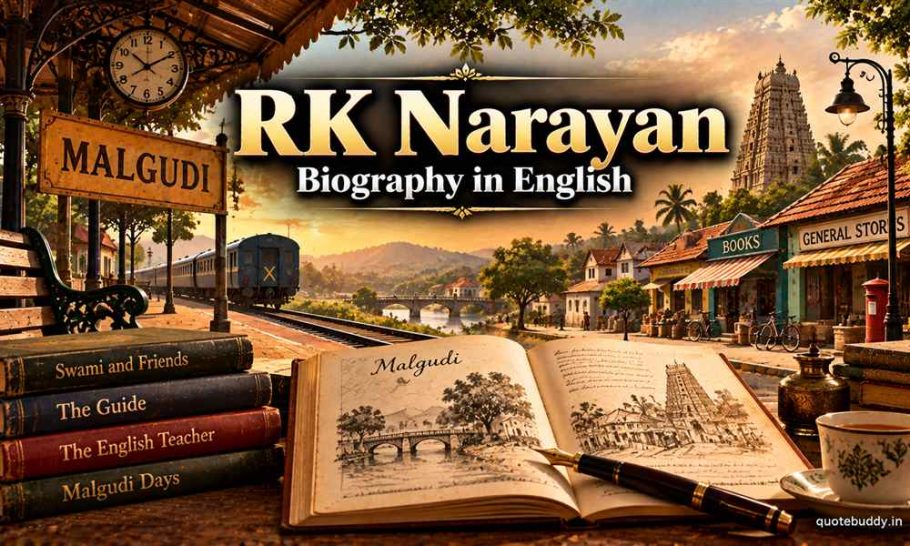
R. K. Narayan is one of India’s most celebrated English-language authors, best known for creating the fictional South Indian town of Malgudi, which became the setting for many of his beloved novels and short stories. This biography of RK Narayan looks at his early life, his literary beginnings, the creation of Malgudi, his major works, and his lasting legacy in Indian literature.
Early Life
Rasipuram Krishnaswami Narayan, popularly known as R. K. Narayan, was born on 10 October 1906 in Madras, now Chennai, India. He grew up in a traditional South Indian family and spent part of his childhood in Mysore with his maternal grandmother. His grandmother played an important role in his early life and education. Narayan developed a love for reading at a young age and enjoyed books, stories, and language. The people and places around him later became an important source of inspiration for his writing.
Narayan was a quiet and observant child who paid close attention to everyday life. He studied in several schools and gradually developed a strong interest in English literature. His early experiences in South India helped shape the simple and realistic style for which he later became famous. Instead of writing only about great historical events, he preferred to describe ordinary people, families, students, teachers, shopkeepers, and neighbours. These everyday experiences became the foundation for the fictional world that he would create in his novels and short stories.
Education and Early Career
Narayan completed his schooling in Mysore and later studied at Maharaja’s College in Mysore. He initially faced difficulties with his studies and took longer than expected to complete his degree. After graduating, he briefly worked as a teacher but soon realised that writing was his true interest. He wanted to become a full-time writer even though it was not considered a secure career. Narayan spent considerable time reading English literature and practising his own writing. His decision to follow literature eventually shaped one of India’s most successful literary careers.
In the early years of his career, Narayan wrote articles and stories for newspapers and magazines. His first novel, Swami and Friends, was published in 1935. The book introduced readers to the fictional South Indian town of Malgudi and its young characters. The novel attracted attention for its simple language, gentle humour, and realistic portrayal of everyday life. Narayan continued to write despite the limited opportunities available to Indian writers in English at that time. His early success encouraged him to make writing his lifelong profession.
Creation of Malgudi
Malgudi is one of the most important creations in R. K. Narayan’s literary career. It is a fictional town in South India that first appeared in Swami and Friends. Although Malgudi does not exist as a real town, Narayan gave it streets, schools, shops, railway stations, homes, temples, and neighbourhoods that felt familiar to Indian readers. The town became a setting where ordinary people experienced friendship, family problems, education, work, love, ambition, and change. Through Malgudi, Narayan created a small world that represented many aspects of Indian society.
Malgudi appeared in many of Narayan’s novels and short stories throughout his career. Characters often returned to familiar places, allowing readers to see the town develop over time. Narayan’s writing did not depend on dramatic events or complicated language. Instead, he found humour and meaning in simple situations and human relationships. His descriptions of Malgudi made the fictional town feel real to generations of readers. Today, Malgudi is closely connected with Narayan’s name and remains one of the best-known fictional settings in Indian English literature.
Major Works
R. K. Narayan wrote many novels, short stories, essays, travel books, and autobiographical works. Some of his best-known novels include Swami and Friends, The Bachelor of Arts, The English Teacher, Mr. Sampath, The Financial Expert, Waiting for the Mahatma, The Guide, The Man-Eater of Malgudi, and The Vendor of Sweets. His stories often focused on ordinary people facing everyday problems. Through humour and simple storytelling, Narayan explored subjects such as education, family relationships, ambition, friendship, social change, and the search for happiness.
The Guide, published in 1958, became one of Narayan’s most famous novels. It tells the story of Raju, a railway guide whose life changes in unexpected ways. The novel won the Sahitya Akademi Award and was later adapted into a successful Hindi film. Another important work, The English Teacher, was influenced by Narayan’s personal experience of losing his wife. His writing combined Indian settings and characters with clear English, helping international readers understand everyday Indian life through fiction.
Recognition and Awards
R. K. Narayan became one of the leading Indian writers in English during the twentieth century. His books were published and read in many countries, and his stories introduced international readers to ordinary Indian life without making it seem exotic or unfamiliar. He received the Sahitya Akademi Award in 1960 for The Guide. His writing was also praised by major literary figures, including Graham Greene, who helped bring attention to Narayan’s early novels. Narayan’s growing international reputation helped establish Indian English literature as an important literary tradition.
Narayan received several major honours during his long career. He was awarded the Padma Bhushan in 1964 and the Padma Vibhushan in 2000 for his contribution to Indian literature. He was also nominated to the Rajya Sabha in 1989, where he served for one term. His books continued to be translated into many Indian and foreign languages. Narayan’s success was especially significant because he developed a distinctly Indian voice while writing in English. His simple style made his work accessible to students, general readers, and literature enthusiasts across generations.
Legacy
R. K. Narayan’s greatest contribution was his ability to present Indian life through simple, natural English. His stories showed that ordinary experiences could become meaningful subjects for literature. Instead of depending on grand events, he wrote about schoolchildren, families, shopkeepers, teachers, businessmen, travellers, and other everyday people. His gentle humour and understanding of human nature made his characters memorable. Malgudi became a lasting symbol of his imagination and remains one of the most recognisable fictional places in Indian literature. His books continue to be widely read in schools and colleges.
Narayan also played an important role in establishing the place of Indian writers in English literature. His work demonstrated that Indian experiences, customs, relationships, and social changes could be expressed naturally in English without losing their local character. Writers and readers around the world continue to study his novels and short stories. His works have been adapted for films and television, including the popular series Malgudi Days. R. K. Narayan died on 13 May 2001 in Chennai, but his characters, stories, and fictional town of Malgudi remain an enduring part of Indian literature.
Quick Facts
- Full Name: Rasipuram Krishnaswami Narayan
- Born: 10 October 1906, Madras (now Chennai)
- Died: 13 May 2001, Chennai
- Known For: Creator of the fictional town of Malgudi; pioneer of Indian English literature
- Major Works: Swami and Friends, The Guide, The English Teacher, The Financial Expert, The Man-Eater of Malgudi
- Major Awards: Sahitya Akademi Award (1960), Padma Bhushan (1964), Padma Vibhushan (2000)
Timeline
- 1906: Born in Madras (now Chennai)
- 1935: Published his first novel, Swami and Friends, introducing the fictional town of Malgudi
- 1958: Published The Guide, later winning the Sahitya Akademi Award
- 1960: Received the Sahitya Akademi Award for The Guide
- 1964: Received the Padma Bhushan
- 1989: Nominated to the Rajya Sabha, serving one term
- 2000: Received the Padma Vibhushan
- 2001: Died on 13 May in Chennai
Why It Matters
R. K. Narayan’s creation of Malgudi gave Indian English literature one of its most enduring and beloved fictional settings, demonstrating that the everyday lives of ordinary Indians, their families, schools, shops, and communities, could form the basis of great literature without needing dramatic or exotic events. His simple, accessible prose style helped establish Indian writers’ place in English literature at a time when such opportunities were limited, and he was championed internationally by figures like Graham Greene. His novel The Guide, adapted into a successful Hindi film, remains one of the most celebrated works of Indian fiction. Narayan’s influence continues through the widespread reading of his books in Indian schools and colleges, as well as through adaptations such as the television series Malgudi Days, which introduced his fictional world to new generations.
Recommended Book
If you want to explore Malgudi and RK Narayan’s storytelling for yourself, his novels are available on Amazon: RK Narayan Books on Amazon.in
Frequently Asked Questions
Q1. Who was RK Narayan?
RK Narayan was a celebrated Indian author known for creating the fictional South Indian town of Malgudi and for helping establish Indian English literature as a major literary tradition.
Q2. What is Malgudi?
Malgudi is a fictional town in South India created by RK Narayan, first appearing in his 1935 novel Swami and Friends, which served as the setting for many of his later novels and short stories.
Q3. What are RK Narayan’s most famous books?
RK Narayan’s most famous books include Swami and Friends, The Guide, The English Teacher, The Financial Expert, and The Man-Eater of Malgudi.
Q4. What awards did RK Narayan receive?
RK Narayan received the Sahitya Akademi Award in 1960 for The Guide, the Padma Bhushan in 1964, and the Padma Vibhushan in 2000.
Q5. What television series was based on RK Narayan’s work?
The popular television series Malgudi Days was based on RK Narayan’s short stories and novels set in the fictional town of Malgudi.
Also read: Biography of Rabindranath Tagore
