
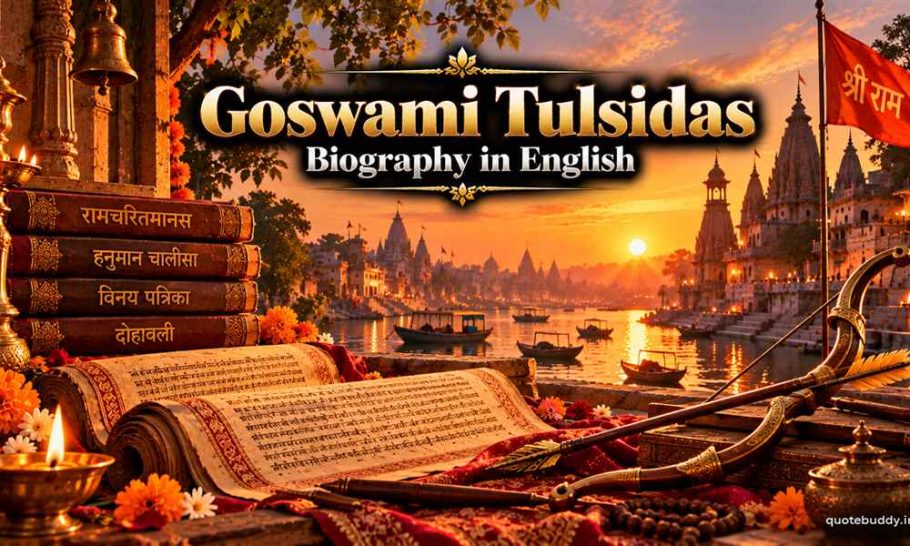
Goswami Tulsidas was a 16th-century poet and saint best known for writing the Ramcharitmanas, the devotional epic that retold the story of Lord Rama in the Awadhi language for ordinary people. His works, including the widely recited Hanuman Chalisa, remain central to Hindu devotional practice even today. This biography looks at his early life, spiritual awakening, major works, literary style, later life and lasting legacy.
Early Life
Goswami Tulsidas was a famous Indian poet, saint and devotee of Lord Rama. He is best known for writing the Ramcharitmanas, a devotional epic that tells the story of Lord Rama in the Awadhi language. Tulsidas is generally believed to have been born in the 16th century in the region of present-day Uttar Pradesh. Traditional accounts give his birthplace as Rajapur, in the Banda region. His life story contains many religious traditions and legends, so some details about his childhood and birth remain uncertain.
According to popular accounts, Tulsidas was born to Atmaram Dubey and Hulsi. Tradition says that he faced difficulties during his early childhood and spent part of his life away from his parents. He later received guidance from religious teachers and developed an interest in Hindu scriptures and devotional stories. His early experiences are described differently in various biographies, but his devotion to Lord Rama became the central part of his life. Over time, Tulsidas became a respected spiritual teacher whose poetry helped ordinary people connect with religious ideas through familiar language.
Spiritual Awakening
Traditional stories say that Tulsidas was married to Ratnavali before becoming deeply devoted to spiritual life. He is believed to have been strongly attached to his wife. One popular account describes how Ratnavali reminded him that the love he showed her could be directed towards Lord Rama instead. Her words are said to have changed his outlook and encouraged him to follow a life of devotion. Although historians cannot confirm every detail of this story, it remains an important part of the traditional account of Tulsidas’s spiritual transformation.
After this turning point, Tulsidas devoted himself to the worship of Lord Rama and the study of religious texts. He travelled to sacred places, met other devotees and shared stories from the Ramayana. His faith taught him that sincere devotion, good conduct and compassion were important parts of a meaningful life. He believed that people could develop a close relationship with God through prayer, remembrance and service. His spiritual journey gradually influenced his writing, allowing him to present religious teachings in language that ordinary people could understand and appreciate.
The Ramcharitmanas and Other Works
Tulsidas’s most famous work is the Ramcharitmanas, which retells the story of Lord Rama in Awadhi, a language widely understood in northern India. It draws inspiration from the Sanskrit Ramayana traditionally associated with Valmiki and presents Rama’s life, values and devotion in a form accessible to a broad audience. The work is divided into seven sections, known as kands, covering major events from Rama’s life. Through its stories, conversations and devotional verses, the Ramcharitmanas became one of the most influential religious and literary works in Hindi-speaking regions.
Apart from the Ramcharitmanas, Tulsidas is traditionally credited with several other devotional works. These include the Hanuman Chalisa, a popular prayer dedicated to Lord Hanuman, and Vinaya Patrika, a collection of devotional prayers. Other works associated with him include Kavitavali, Gitavali and Dohavali. His writings explore faith, humility, duty, courage and the importance of remembering God. Many of his verses are recited during religious gatherings, festivals and daily prayers. His works helped make devotional literature an important part of everyday spiritual life for countless people.
Literary Style and Devotion to Rama
Tulsidas used simple, expressive language to communicate deep spiritual ideas. His writing often combines storytelling, poetry, dialogue and memorable descriptions of people and events. By writing the Ramcharitmanas in Awadhi rather than only in Sanskrit, he helped make the story of Lord Rama accessible to people who might not understand classical religious texts. His verses express a range of emotions, including love, sadness, courage and hope. The rhythm and musical quality of his poetry also made it suitable for singing and recitation in homes, temples and community gatherings.
Devotion to Lord Rama was the central theme of Tulsidas’s life and literary work. He presented Rama as an ideal ruler, a devoted son, a loyal husband and a symbol of righteousness. Through Rama’s actions, Tulsidas highlighted values such as truth, duty, kindness and respect for others. He also praised Lord Hanuman for his courage, humility and unwavering service to Rama. His writings encouraged people to develop faith while following good moral principles in daily life. These teachings helped establish his reputation as one of India’s most important devotional poets.
Later Life
Traditional accounts associate Tulsidas with several sacred places, especially Varanasi, Ayodhya and Chitrakoot. These locations are closely connected with the stories of Lord Rama and have remained important centres of Hindu devotion. Tulsidas is believed to have spent much of his later life composing devotional poetry, teaching spiritual ideas and encouraging people to remember Lord Rama. His works were shared through recitations and religious gatherings, allowing his message to reach people from different backgrounds. Over time, his reputation as a poet and saint spread throughout northern India.
Many details about Tulsidas’s later years come from traditional biographies rather than fully verified historical records. He is generally believed to have died in Varanasi around the early 17th century, with 1623 often given as the year of his death. Stories about his life describe his deep faith, simple habits and commitment to devotional service. His followers continued sharing his writings after his death, and his verses became an important part of religious and cultural traditions. Through the continued recitation of his works, his spiritual message remained alive across generations.
Legacy
Goswami Tulsidas is remembered as one of the greatest devotional poets in Indian literary history. His Ramcharitmanas made the story of Lord Rama widely accessible and became an important text for religious study, storytelling and performance. Its verses are recited in temples and homes, while episodes from the epic are performed during festivals such as Ram Lila. His writing helped shape the cultural and spiritual traditions of northern India. Tulsidas’s ability to combine devotion with powerful storytelling made his work meaningful to people across generations and social backgrounds.
His influence continues through devotional songs, prayers, theatre, television adaptations and everyday religious practices. The Hanuman Chalisa, traditionally attributed to him, remains one of the most widely recited Hindu devotional hymns. Tulsidas’s writings encourage faith, humility, courage, compassion and commitment to moral duty. They also demonstrate the lasting power of writing in a language that people can understand and share. Although centuries have passed since his lifetime, his works continue to inspire readers, devotees and artists. Goswami Tulsidas’s legacy remains an important part of India’s spiritual, literary and cultural heritage.
गोस्वामी तुलसीदास का जीवन परिचय (Tulsidas Biography in Hindi)
गोस्वामी तुलसीदास भारत के प्रसिद्ध संत, कवि और भगवान श्रीराम के महान भक्त थे। उनका जन्म 16वीं शताब्दी में माना जाता है। परंपरागत मान्यताओं के अनुसार, उनका जन्म उत्तर प्रदेश के वर्तमान बांदा क्षेत्र के राजापुर में हुआ था। उनके बचपन और जन्म से जुड़ी कई कथाएं प्रचलित हैं, हालांकि सभी ऐतिहासिक रूप से प्रमाणित नहीं हैं। बचपन से ही उनके जीवन में अनेक कठिनाइयों का उल्लेख मिलता है।
कहा जाता है कि तुलसीदास का विवाह रत्नावली से हुआ था। एक पारंपरिक कथा के अनुसार, रत्नावली की सीख ने उन्हें सांसारिक मोह से उठकर भगवान श्रीराम की भक्ति के मार्ग पर चलने के लिए प्रेरित किया। इसके बाद उन्होंने अपना जीवन भक्ति, धार्मिक अध्ययन और साहित्य की रचना में समर्पित कर दिया।
तुलसीदास की सबसे प्रसिद्ध रचना रामचरितमानस है, जिसमें उन्होंने अवधी भाषा में भगवान श्रीराम के जीवन और आदर्शों का वर्णन किया। उनकी अन्य प्रसिद्ध रचनाओं में हनुमान चालीसा, विनय पत्रिका और दोहावली शामिल हैं। उनकी रचनाएं सत्य, धर्म, विनम्रता और करुणा का संदेश देती हैं। तुलसीदास का निधन वाराणसी में हुआ माना जाता है। आज भी उनकी रचनाएं मंदिरों, घरों और धार्मिक आयोजनों में पढ़ी जाती हैं। उनका साहित्य भारतीय संस्कृति और भक्ति परंपरा की अमूल्य धरोहर है।
Quick Facts
- Full Name: Goswami Tulsidas
- Period: 16th-17th century (c. 1532-1623)
- Birthplace: Rajapur, Banda region, Uttar Pradesh
- Profession: Poet, Saint, Devotional Writer
- Major Works: Ramcharitmanas, Hanuman Chalisa, Vinaya Patrika, Kavitavali, Dohavali
Timeline
- 16th century: Born in Rajapur, present-day Uttar Pradesh
- Youth: Married to Ratnavali; spiritual awakening towards devotion to Rama
- Adulthood: Composed the Ramcharitmanas in Awadhi language
- ~1623: Died in Varanasi
Why It Matters
Tulsidas’s decision to write the Ramcharitmanas in Awadhi rather than Sanskrit made the story of Lord Rama accessible to millions of ordinary people, shaping devotional practice and literature in northern India for centuries. His works remain central to religious life, festivals and everyday prayer even today.
Recommended Book
For readers interested in Tulsidas’s poetry and the Ramcharitmanas, several translated editions are available. Search for Tulsidas and Ramcharitmanas books on Amazon.in.
Frequently Asked Questions
Q1. What is Tulsidas most famous for?
He is most famous for writing the Ramcharitmanas, a devotional retelling of the Ramayana in the Awadhi language.
Q2. Did Tulsidas write the Hanuman Chalisa?
Yes, the Hanuman Chalisa is traditionally attributed to Tulsidas and remains one of the most widely recited Hindu prayers.
Q3. When did Tulsidas live?
He is generally believed to have lived in the 16th and early 17th centuries, dying around 1623 in Varanasi.
Q4. Why did Tulsidas write in Awadhi instead of Sanskrit?
He wrote in Awadhi so that ordinary people, who could not understand classical Sanskrit texts, could access the story and teachings of Lord Rama.
Also read: Sant Kabir Das Biography in English
