
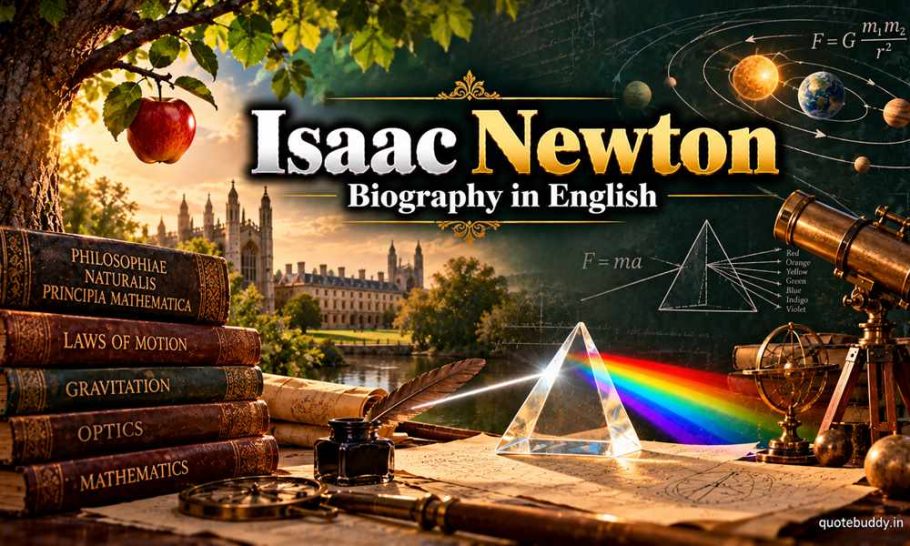
Isaac Newton was one of the most important scientists in history, known for his laws of motion, his theory of universal gravitation, and his major contributions to mathematics and optics. This biography of Isaac Newton looks at his early life, his education at Cambridge, his scientific discoveries, and the lasting legacy that Newton left on modern science.
Early Life
Isaac Newton was born on 4 January 1643 in Woolsthorpe, Lincolnshire, England. His childhood was not easy, but he showed strong interest in learning and building things. As a young student, he developed a deep curiosity about nature, numbers, and how the world worked. He later attended The King’s School in Grantham, where he studied subjects that prepared him for higher education. His early interest in science and mathematics became the foundation for the remarkable work he would produce later in life.
Newton grew up during a period when many questions about nature and the universe were being explored. He became especially interested in mathematics, astronomy, and physical objects. Instead of accepting simple explanations, Isaac Newton tried to understand the rules behind natural events. His habit of careful thinking helped shape his scientific approach. These early interests eventually led him toward Cambridge, where he would develop many of the ideas that made him one of the most important scientists in history.
Education at Cambridge
Isaac Newton entered Trinity College, Cambridge, in 1661. At Cambridge, he studied mathematics, philosophy, and other subjects while also reading the works of important thinkers. His interest in mathematics and natural philosophy grew rapidly during his student years. Newton spent considerable time studying ideas beyond his formal lessons, developing his own questions about motion, light, and the universe.
During his years at Cambridge, Newton began producing important ideas in mathematics and science. The university provided him with access to books, teachers, and an intellectual environment where he could develop his interests. When Cambridge closed temporarily because of the plague, he returned to Woolsthorpe and continued his private studies. This period became especially productive for Newton, as he developed ideas that would later influence mathematics, optics, and mechanics.
Laws of Motion and Gravity
Newton’s laws of motion became a foundation of classical physics. They explained how objects move and how forces affect their motion. He presented these laws in his famous work Philosophiae Naturalis Principia Mathematica, published in 1687. The book also presented his law of universal gravitation, which explained how objects attract one another through gravity.
Newton’s theory of gravity connected events on Earth with the movement of objects in space. His ideas provided a mathematical way to understand the motion of planets and other bodies. The laws of motion and universal gravitation became extremely influential in science. Together, they helped establish a systematic framework for studying motion and forces and remained central to physics for many generations.
Work in Mathematics and Optics
Newton made major contributions to mathematics, including the development of methods that became part of calculus. His mathematical work helped provide new tools for studying changing quantities and motion. At the same time, Isaac Newton carried out important experiments with light. His studies of prisms showed that white light can be separated into different colours.
Newton’s work in optics also examined the nature of colour and the behaviour of light. He built a reflecting telescope that used mirrors instead of lenses to form an image. His experiments and inventions helped improve understanding of light and also demonstrated his practical approach to scientific problems. Mathematics and optics therefore became two important areas of his wide-ranging scientific work.
Later Life and Positions
Newton became a professor at Cambridge and continued his scientific and mathematical work. His reputation grew because of his discoveries in physics, mathematics, and optics. He was later elected a Fellow of the Royal Society, an important scientific organisation in England. His position within the scientific community reflected the growing recognition of his contributions.
In later life, Newton moved into important public positions. He became Warden of the Royal Mint and later Master of the Royal Mint, where he worked on matters connected with England’s currency. He also served as President of the Royal Society. Newton was knighted in 1705, becoming Sir Isaac Newton. His later career therefore included both scientific leadership and important public responsibilities.
Legacy
Isaac Newton died on 31 March 1727 in London. His work had already transformed important areas of science and mathematics. His laws of motion and theory of universal gravitation became fundamental parts of classical physics. His studies of light and colour also influenced later scientific work. Newton’s ability to connect mathematics with observations of the natural world made his approach especially important.
Newton remains one of the most influential scientists in history. His ideas shaped physics, astronomy, mathematics, and optics for centuries. His book Principia Mathematica became one of the landmark works of scientific history. Although later scientists developed theories that went beyond some of his ideas, Newton’s contributions remain fundamental to modern science. His legacy continues through the scientific methods, mathematical tools, and physical principles associated with his name.
Quick Facts
- Full Name: Sir Isaac Newton
- Born: 4 January 1643, Woolsthorpe, Lincolnshire, England
- Died: 31 March 1727, London
- Known For: Laws of motion, theory of universal gravitation, calculus, work in optics
- Major Work: Philosophiae Naturalis Principia Mathematica (1687)
- Positions Held: Professor at Cambridge, President of the Royal Society, Master of the Royal Mint
Timeline
- 1643: Born in Woolsthorpe, Lincolnshire, England
- 1661: Entered Trinity College, Cambridge
- Plague years: Returned to Woolsthorpe and developed key ideas in mathematics and physics
- 1687: Published Principia Mathematica, presenting the laws of motion and universal gravitation
- Royal Society: Elected a Fellow and later served as President
- 1699-1727: Served as Warden and later Master of the Royal Mint
- 1705: Knighted, becoming Sir Isaac Newton
- 1727: Died in London on 31 March
Why It Matters
Isaac Newton’s laws of motion and theory of universal gravitation laid the foundation for classical physics and remained the standard explanation of motion and gravity for more than two centuries. Newton’s development of calculus gave scientists and mathematicians powerful new tools for studying change and motion, tools that are still used across science and engineering today. His experiments with light and prisms transformed the understanding of optics and colour, while his reflecting telescope improved the tools available to astronomers. As President of the Royal Society and a leading figure of his era, Newton helped shape the direction of scientific thought, and his book Principia Mathematica remains one of the most influential works in the history of science.
Recommended Book
If you want to learn more about Isaac Newton’s life and discoveries, consider reading a detailed biography available on Amazon: Isaac Newton Biography Books on Amazon.in
Frequently Asked Questions
Q1. Who was Isaac Newton?
Isaac Newton was an English physicist and mathematician, best known for his laws of motion and his theory of universal gravitation, and widely regarded as one of the most influential scientists in history.
Q2. What is Newton famous for?
Newton is famous for formulating the laws of motion and the law of universal gravitation, developing methods that became part of calculus, and conducting important experiments in optics.
Q3. What is Newton’s most famous book?
Newton’s most famous book is Philosophiae Naturalis Principia Mathematica, published in 1687, which presented his laws of motion and theory of gravity.
Q4. Where did Isaac Newton study?
Isaac Newton studied at Trinity College, Cambridge, starting in 1661, where he developed many of the ideas that later made him famous.
Q5. What positions did Newton hold later in life?
Newton served as a professor at Cambridge, President of the Royal Society, and Warden and later Master of the Royal Mint, and he was knighted in 1705.
Also read: Biography of APJ Abdul Kalam
