
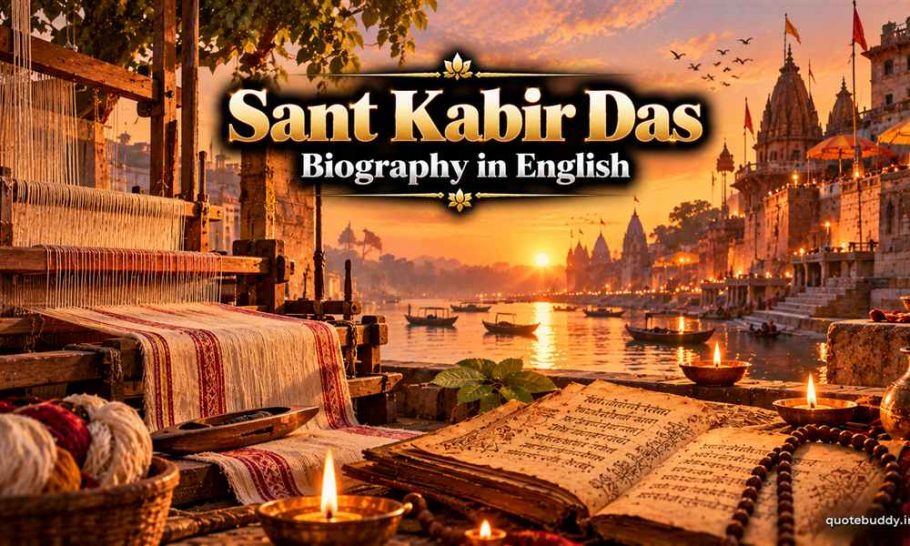
Sant Kabir Das was a 15th-century mystic poet and saint whose simple dohas and teachings on religious harmony continue to inspire readers across India. Rising from humble beginnings as a weaver in Varanasi, his message of devotion, honesty and unity transcended religious divisions between Hindus and Muslims. This biography looks at his early life, spiritual teachings, poetry, his role in promoting religious harmony, the legend of his death and his lasting legacy.
Early Life
Sant Kabir Das was a famous Indian mystic poet, saint and spiritual teacher whose words continue to inspire people across India. He is generally believed to have lived during the 15th century, although some details of his life remain uncertain. According to popular tradition, he was found as an infant near Lahartara Lake in Varanasi by a Muslim weaver named Neeru and his wife, Neema, who raised him. Kabir grew up in a humble family and became familiar with the daily struggles of ordinary working people.
Kabir is believed to have worked as a weaver, following the family occupation while developing his spiritual ideas. Unlike many religious scholars of his time, he did not depend on formal education to share his understanding of life and God. He learned through observation, personal experience and conversations with people from different backgrounds. Traditional accounts connect him with the Hindu teacher Ramananda, although historians do not agree on every detail of this relationship. Kabir’s simple lifestyle and direct way of speaking later became important features of his spiritual teachings.
Spiritual Teachings and Philosophy
Sant Kabir Das taught that God is one and that people can experience the divine through sincere devotion, love and an honest life. He believed that God could not be limited to a particular temple, mosque, religious book or ritual. According to Kabir, a person’s inner thoughts and actions mattered more than outward religious appearances. He encouraged people to control their ego, speak truthfully and treat others with kindness. His teachings used simple language and familiar examples, making difficult spiritual ideas easier for ordinary people to understand.
Kabir also questioned blind faith, empty rituals and the idea that a person’s worth depended on caste or social position. He believed that spiritual wisdom was available to everyone, regardless of wealth, family background or religion. He encouraged people to look within themselves instead of blaming others or following customs without understanding their meaning. His message focused on self-awareness, humility and love for all human beings. Kabir’s teachings were sometimes challenging because they questioned powerful social and religious traditions. Even today, many readers find his ideas relevant to questions about equality, compassion and genuine faith.
Kabir’s Poetry (Dohas) and Works
Kabir is best known for his short poems called dohas, which express deep ideas in a few simple lines. His poetry uses everyday examples from work, family life and nature to explain spiritual truths. He often wrote about the human mind, pride, kindness and the search for God. His verses were shared orally and passed from one generation to another. As a result, different versions of some poems exist today. The simple language and memorable rhythm of his dohas helped people from different educational and social backgrounds connect with his message.
One of Kabir’s widely known dohas begins, “Bura jo dekhan main chala, bura na milya koi,” which teaches that people should examine their own faults before judging others. Another popular verse uses the image of a slowly growing tree to remind people that good results take time. Kabir’s poetry was later collected in various traditions and texts, including the Bijak and the Kabir Granthavali. Several of his verses are also included in the Guru Granth Sahib, the sacred scripture of Sikhism. These works preserve his reflections on devotion, truth and human behaviour.
Kabir and Religious Harmony
Sant Kabir Das lived in a society where religious identity and social divisions often shaped people’s lives. His teachings challenged the belief that one religious community was naturally superior to another. He criticised practices among both Hindus and Muslims when he believed they encouraged pride, division or empty ritual. Kabir argued that the same divine reality could be approached through sincere love and understanding. His message encouraged people to look beyond religious labels and recognise the humanity they shared. This made his poetry meaningful to people from different religious traditions.
Kabir’s influence can be seen in the Kabir Panth, a spiritual tradition whose followers respect his teachings and poetry. His verses have also been valued by many Hindu, Muslim and Sikh communities. Rather than encouraging people to fight over religious differences, Kabir asked them to develop kindness, self-control and spiritual understanding. His message did not mean that every religion was identical; instead, it questioned hatred and the misuse of religion to create divisions. For modern readers, Kabir’s work offers a reminder that respectful dialogue and shared human values can help communities live together peacefully.
Death and the Legend at Maghar
Traditional accounts place Sant Kabir Das’s death at Maghar, a town in present-day Uttar Pradesh, commonly dated to around 1518, although the exact year is uncertain. Maghar was associated with a popular belief that dying there would lead to an unfortunate afterlife, while dying in Varanasi was considered spiritually favourable by some people. Kabir is remembered for challenging this belief. His teachings suggested that salvation depended on one’s actions and spiritual understanding, not simply on the place where a person died. His association with Maghar became an important part of his story.
A well-known legend says that after Kabir’s death, his Hindu and Muslim followers disagreed about how to perform his final rites. When they lifted the cloth covering his body, they reportedly found flowers instead of a human body. The followers then divided the flowers and performed their respective rites peacefully. This story is understood as a symbolic expression of Kabir’s message of religious harmony rather than a verified historical event. Today, Maghar is an important place associated with his memory, with sites connected to both Hindu and Muslim traditions reflecting the broad influence of his teachings.
Legacy
Sant Kabir Das remains one of India’s most respected spiritual poets. His dohas are taught in schools, quoted in everyday conversations and shared through books, songs and public performances. His ability to explain complex ideas in simple language helped his poetry travel across regions and generations. He encouraged people to question injustice, examine their own behaviour and develop a sincere relationship with God. His teachings also challenged caste discrimination and religious intolerance. Through these ideas, Kabir became an important voice for equality, inner reflection and compassion in Indian spiritual and literary history.
Kabir’s influence continues through the Kabir Panth, folk music traditions and the devotional poetry of many communities. Singers across India perform his verses, often using traditional instruments and melodies to communicate their message to new audiences. His words remain relevant because they encourage people to think beyond pride, prejudice and social divisions. Kabir taught that a meaningful life requires honesty, humility and concern for others. Although centuries have passed since his time, his poetry still invites readers to question themselves and seek a more truthful, compassionate way of living.
संत कबीर दास का जीवन परिचय (Kabir Das Biography in Hindi)
संत कबीर दास भारत के प्रसिद्ध संत, कवि और आध्यात्मिक विचारक थे। माना जाता है कि उनका जीवन 15वीं शताब्दी में था। लोकमान्यताओं के अनुसार, उनका पालन-पोषण वाराणसी के पास एक जुलाहा परिवार में हुआ था। कबीर दास ने अपने जीवन में सादगी, प्रेम, सत्य और मानवता को सबसे अधिक महत्व दिया। वे मानते थे कि ईश्वर एक है और उसे सच्चे मन, भक्ति तथा अच्छे कर्मों के माध्यम से पाया जा सकता है।
कबीर दास ने जाति-पाति, धार्मिक भेदभाव, अंधविश्वास और दिखावे वाले कर्मकांडों का विरोध किया। उन्होंने लोगों को दूसरों की बुराई करने के बजाय अपनी कमियों को पहचानने की सीख दी। उनकी रचनाओं में दोहे विशेष रूप से प्रसिद्ध हैं, जिनमें जीवन और आध्यात्मिकता से जुड़ी गहरी बातें सरल भाषा में समझाई गई हैं। उनकी कविताओं और विचारों का संग्रह बीजक तथा कबीर ग्रंथावली जैसे ग्रंथों में मिलता है। उनके कुछ पद सिख धर्म के पवित्र ग्रंथ गुरु ग्रंथ साहिब में भी शामिल हैं।
कबीर दास की मृत्यु के बारे में माना जाता है कि वे मगहर में अंतिम समय तक रहे। आज भी उनके दोहे लोगों को सत्य, समानता, प्रेम और धार्मिक सद्भाव का संदेश देते हैं। उनकी शिक्षाएं भारतीय साहित्य और संस्कृति की अमूल्य धरोहर हैं।
Quick Facts
- Full Name: Sant Kabir Das
- Period: 15th century (exact dates uncertain)
- Birthplace: Near Lahartara Lake, Varanasi
- Profession: Weaver, Mystic Poet, Spiritual Teacher
- Known For: Dohas (couplets), teachings on religious harmony and devotion
- Major Works: Bijak, Kabir Granthavali, verses in the Guru Granth Sahib
Timeline
- 15th century: Born near Lahartara Lake, Varanasi
- Youth: Raised by weaver parents Neeru and Neema
- Adulthood: Composed dohas blending Hindu and Sufi spiritual thought
- ~1518: Died at Maghar, Uttar Pradesh
Why It Matters
Kabir Das’s teachings on equality, honest living and religious harmony remain deeply relevant in a diverse society like India. His poetry continues to be studied for its simplicity, wisdom and timeless message of compassion across religious and social divides.
Recommended Book
For readers interested in Kabir Das’s poetry and philosophy, several translated collections are available. Search for Kabir Das biography and doha collections on Amazon.in.
Frequently Asked Questions
Q1. What are Kabir’s dohas?
Dohas are short two-line couplets through which Kabir expressed deep spiritual and moral teachings in simple language.
Q2. Was Kabir Hindu or Muslim?
Kabir was raised in a Muslim weaver family but drew on both Hindu and Islamic spiritual traditions, promoting unity beyond religious labels.
Q3. Where did Kabir Das die?
According to tradition, he died at Maghar in present-day Uttar Pradesh, around 1518.
Q4. Is there an autobiography of Kabir Das?
No authenticated autobiography exists; his life is known mainly through oral tradition, legends and his collected poetry such as the Bijak and Kabir Granthavali.
Also read: RK Narayan Biography in English
