
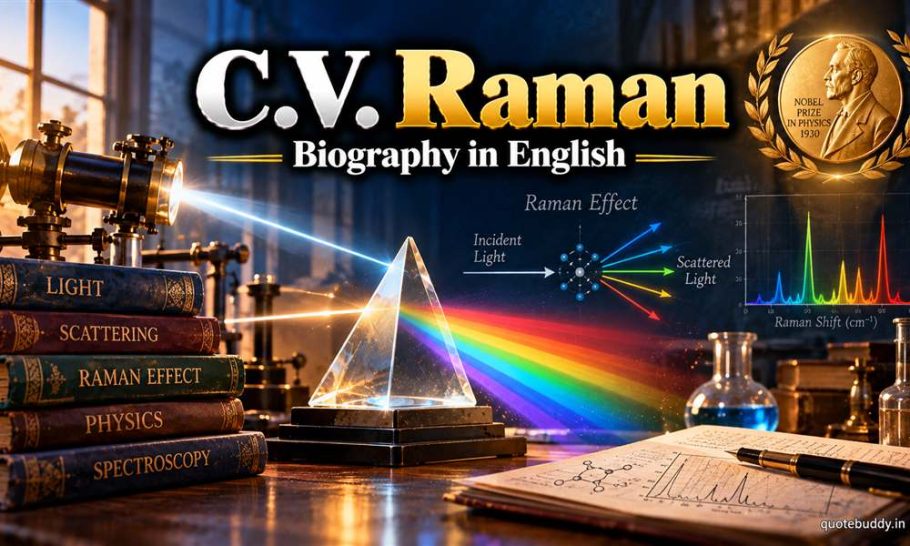
C.V. Raman was one of India’s most celebrated scientists, best known for discovering the Raman Effect, a breakthrough in the study of light scattering that earned him the Nobel Prize in Physics in 1930. This biography of CV Raman looks at his early life, education, scientific discoveries, and lasting legacy in Indian science.
Early Life
CV Raman was born on 7 November 1888 in Thiruvanaikaval, Tamil Nadu. From a young age, he showed talent in physics and developed a strong interest in understanding the natural world. His early ability in science became an important part of his later career. He eventually pursued higher education at Presidency College, Madras, where he continued developing his knowledge of physics. His early years and academic interests prepared him for a scientific career that would later bring international recognition to Indian science.
Raman’s interest in physics continued to grow during his student years. His education at Presidency College, Madras, gave him an important academic foundation. He showed particular talent in physics and later chose science as the main direction of his professional life. Although his first career was connected with government service, his interest in scientific research remained strong. These early experiences eventually led him toward research and an important discovery that changed his place in the history of modern science.
Education and Early Career
CV Raman studied at Presidency College, Madras, where he developed his interest and ability in physics. After completing his education, he worked in the Indian Finance Department. This government position provided his early professional career, but his scientific interests remained important to him. Raman eventually decided to turn fully toward science, choosing research and scientific work instead of continuing his government career.
After leaving the Indian Finance Department, Raman became involved in scientific research at the Indian Association for the Cultivation of Science in Calcutta. This institution provided a place where he could pursue his interest in physics through research. His work there became an important stage in his scientific journey. The research he carried out in Calcutta eventually led to the discovery that would become known as the Raman Effect and bring him worldwide recognition.
Discovery of the Raman Effect
In 1928, CV Raman discovered the Raman Effect, an important scientific discovery related to the scattering of light. His research helped establish a new understanding of how light behaves when it interacts with matter. The discovery became the most important achievement of his scientific career and brought international attention to his work. Raman’s research demonstrated the importance of scientific investigation being carried out in India.
The Raman Effect became closely associated with Raman’s name after its discovery in 1928. His work focused on the scattering of light and became a major contribution to physics. The discovery later received international recognition through the Nobel Prize in Physics. In India, the achievement is also remembered through National Science Day, celebrated on 28 February to mark the discovery of the Raman Effect.
Nobel Prize in Physics
CV Raman received the Nobel Prize in Physics in 1930 for his scientific work. He became the first Asian to win a Nobel Prize in science, making the achievement an important moment in the history of scientific recognition in Asia. The award brought worldwide attention to his research and established his position as one of India’s most recognised scientists.
The Nobel Prize recognised Raman’s contribution to physics through his discovery of the Raman Effect. His achievement showed the international importance of scientific research carried out in India. The 1930 award became a defining moment in his career and strengthened his reputation as a leading physicist. His success also became an important part of India’s scientific history and continued to be remembered long after his Nobel recognition.
Later Research and Institutions
CV Raman continued his scientific work after receiving the Nobel Prize. He became involved in the leadership of the physics department at the Indian Institute of Science. His work in scientific institutions helped support the development of physics research in India. He later established the Raman Research Institute in Bangalore, creating another important centre connected with scientific research and his continuing interest in physics.
Raman’s later career remained connected with scientific research and institution building. His leadership in physics at the Indian Institute of Science was followed by the creation of the Raman Research Institute in Bangalore. These institutions became important parts of his contribution beyond the discovery of the Raman Effect. His work showed a continuing commitment to science and to developing places where scientific research could be pursued in India.
Legacy
CV Raman received the Bharat Ratna in 1954, one of the highest recognitions in India. His scientific achievements, especially the discovery of the Raman Effect, became an important part of the country’s scientific heritage. National Science Day is celebrated in India on 28 February to mark the discovery made in 1928. This annual observance keeps the significance of his scientific work connected with India’s wider appreciation of science.
Raman died on 21 November 1970 in Bangalore. His legacy includes his work in physics, his leadership in scientific institutions, and the Raman Research Institute that he later established. His journey from Presidency College, Madras, through government service and research in Calcutta, led to an internationally recognised scientific discovery. His Nobel Prize, Bharat Ratna, and continuing association with National Science Day remain important parts of his lasting place in Indian science.
Quick Facts
- Full Name: Chandrasekhara Venkata Raman
- Born: 7 November 1888, Thiruvanaikaval, Tamil Nadu
- Died: 21 November 1970, Bangalore
- Known For: Discovery of the Raman Effect (1928)
- Major Award: Nobel Prize in Physics (1930), Bharat Ratna (1954)
- Institutions: Indian Association for the Cultivation of Science, Indian Institute of Science, Raman Research Institute
Timeline
- 1888: Born in Thiruvanaikaval, Tamil Nadu
- Presidency College, Madras: Completed his education in physics
- Indian Finance Department: Began his career in government service
- Indian Association for the Cultivation of Science, Calcutta: Carried out research that led to his major discovery
- 1928: Discovered the Raman Effect
- 1930: Awarded the Nobel Prize in Physics
- Indian Institute of Science: Led the physics department
- Raman Research Institute, Bangalore: Founded this research institution
- 1954: Received the Bharat Ratna
- 1970: Passed away in Bangalore on 21 November
Why It Matters
CV Raman’s discovery of the Raman Effect changed the way scientists understand how light interacts with matter, and it remains a foundational concept in modern physics and chemistry, used today in fields ranging from material science to medical diagnostics. As the first Asian to win a Nobel Prize in science, his achievement also proved that world-class scientific research could be carried out in India, inspiring generations of Indian scientists. His later work building research institutions, including the Raman Research Institute, ensured that his contribution to science extended far beyond his own discoveries. Every year, National Science Day on 28 February honours his legacy and keeps his scientific spirit alive in India.
Recommended Book
If you want to explore more about CV Raman’s life and scientific journey, consider reading a detailed biography available on Amazon: CV Raman Biography Books on Amazon.in
Frequently Asked Questions
Q1. Who was CV Raman?
CV Raman was an Indian physicist best known for discovering the Raman Effect, a scientific breakthrough related to the scattering of light, for which he won the Nobel Prize in Physics in 1930.
Q2. What is the Raman Effect?
The Raman Effect describes how light changes when it scatters off molecules, a discovery that became fundamental to the study of light and matter in physics and chemistry.
Q3. When did CV Raman win the Nobel Prize?
CV Raman won the Nobel Prize in Physics in 1930, becoming the first Asian to win a Nobel Prize in science.
Q4. Why is National Science Day celebrated on 28 February?
National Science Day is celebrated on 28 February every year in India to mark the date in 1928 when CV Raman discovered the Raman Effect.
Q5. What awards did CV Raman receive?
CV Raman received the Nobel Prize in Physics in 1930 and the Bharat Ratna, India’s highest civilian award, in 1954.
Also read: Biography of APJ Abdul Kalam
